The Portfolio Trap: When More Examples Make Your Work Harder to Read
A portfolio can lose its point when it tries to show everything. Choose work around one clear question so readers can see your strongest contribution.
You add one more piece to your portfolio, then another, and the story gets harder to see. A portfolio with too many examples can bury the very skill you want a reader to notice. The fix is not simply to make the collection shorter; it is to choose pieces that answer one clear question.
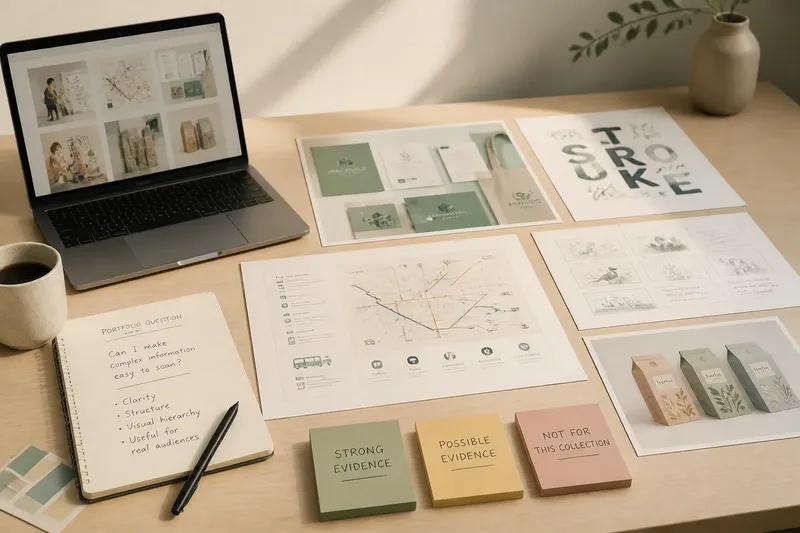
That question might be, “Can this designer make complex information easy to scan?” or “Can this illustrator create warmth with a restrained palette?” It gives each example a job. Instead of asking whether a piece is impressive on its own, ask whether it helps a reader understand the work you want to be considered for.
Why does a portfolio get harder to read as it grows?
Every item asks for attention. A reader has to identify what it is, infer your role, judge its relevance, and decide what to look at next. When the collection includes unrelated work without a clear thread, those decisions multiply. The result can feel less like range and more like a drawer of samples.
Variety itself is not the problem. A single person may work in different materials, for different audiences, or across several stages of a project. The trouble starts when the portfolio leaves the reader to invent the connection. If one page shows a playful packaging concept, another shows dense technical diagrams, and a third shows an unfinished personal study, the reader may struggle to tell which kind of work you want to do.
There is also a difference between showing range and showing every available piece. Range becomes legible when examples relate through a recognizable ability: careful editing, strong composition, a feel for materials, or a knack for making a complicated process understandable. Without that thread, adding more examples often adds more questions rather than more confidence.
What question should your collection answer?
Start with the reader’s decision. A hiring manager, curator, client, or collaborator may be asking different things, so a portfolio does not need to represent your entire creative identity in equal measure. It should make the most relevant evidence easy to find.
Write a plain-language question that names an ability, not a vague quality. “Am I creative?” is too broad to guide selection. “Can I develop clear visual identities for small cultural organizations?” points toward work a reader can recognize and compare.
Try drafting a sentence with this shape: “These pieces show how I…” Finish it with a specific action or strength. For example, “These pieces show how I turn scattered notes into a clear editorial structure.” If the sentence can describe almost anyone’s portfolio, sharpen it. If it excludes work you care about, adjust it until it reflects the opportunity and the evidence you can genuinely present.
Keep the question close while reviewing. A beautiful piece may still be a poor fit for this particular collection. That does not make it bad work; it may belong in another portfolio, a separate section, or nowhere public for now.
How can you shape a portfolio over a week?
A week gives the task a useful boundary without requiring a dramatic overhaul. Treat it as a sequence of editorial decisions, not a hunt for a perfect collection. Set aside short, focused sessions and stop each one with a clear next action.
Day one: define the reader and the question
Name the person you want the portfolio to help: perhaps an art director seeking an illustrator, a workshop organizer looking for a facilitator, or a prospective client considering a brand designer. Then write one question that person is likely to have. Keep it beside your working files, where it can challenge choices that feel attractive but irrelevant.
Do not try to answer every possible question at once. A portfolio for an editorial illustration commission may emphasize narrative images and collaboration with editors. A collection aimed at teaching opportunities may need to foreground explanation, preparation, and the ability to make a process understandable. One clear purpose makes selection less slippery.
Day two: gather without editing
Collect the work you could reasonably include: finished projects, selected process images, prototypes, and personal work if it supports the question. Put files in one folder or lay physical pieces on a table. Add a short note to each item: what it is, what you did, and why it might belong.
This is a temporary inventory, not a promise to publish everything. Gathering first prevents the portfolio from being shaped only by whatever happens to be easiest to access. It can also reveal missing context: a polished image may need a caption explaining whether you led the work, contributed one component, or developed it as an independent study.
Day three: sort by evidence
Make three groups: strong evidence, possible evidence, and not for this collection. Judge each piece against the central question. A strong item shows the ability directly. A possible item may add a different angle but need explanation. A piece in the last group may be worth keeping elsewhere without taking space here.
Look for repeated proof, not just repeated formats. Three posters may show the same strength in distinct ways, while a poster, a storyboard, and a package may all demonstrate clear visual hierarchy. The question is whether each item teaches the reader something new about your work.
Day four: choose the lead and supporting pieces
Pick the clearest example to lead. It should help a reader understand the collection quickly, not merely be the newest or most elaborate piece. Then choose supporting work that adds useful evidence, such as a different audience, a distinct constraint, or a strong example of your process.
Imagine a designer assembling work for a role focused on public-facing information. They have a polished event identity, a set of illustrated transit directions, and an experimental lettering poster. They lead with the directions because those make the central ability visible; the identity adds evidence of coherent visual systems, while the poster stays out because its main strength is expressive lettering rather than clarity. The expected result is a collection whose purpose a reader can grasp without guessing at the connection.
Day five: write captions that reveal your contribution
A caption should orient the reader, not narrate every decision. Identify the project and audience, state your role, and mention the constraint or creative problem that matters to the central question. If the work was collaborative, name your contribution clearly rather than implying that you made everything.
For instance, “Illustration for a community garden’s volunteer guide; I developed the visual system and drew the planting diagrams” gives more useful context than “Garden guide.” Avoid padded claims such as “I worked on various aspects.” If the precise role is difficult to describe, pause and clarify it before publishing.
Day six: check the reading order
View the portfolio as a stranger would. Open the landing page, move through the sequence, and ask what each piece adds. Does the first screen set up the question? Does a later example strengthen or muddy it? Could a reader tell what you personally contributed?
Use a simple test: after each item, finish the sentence “Now I can see that this person can…” If the sentence repeats an earlier point, the item may be redundant. If it introduces an unrelated claim, it may belong in a separate collection. If the answer is unclear, the caption or ordering may need attention before the work is removed.
Day seven: publish a deliberate version
Make the chosen edits, check that links and images work, and publish the version you can stand behind. Save the excluded work and your selection notes in a separate folder. That keeps good material available without turning the public portfolio into a storage system.
Leave a brief note for your next review: what question this version answers, what evidence it uses, and what kind of opportunity would justify changing it. This gives future editing a starting point. You are not locking yourself into one identity; you are making the current collection easier to understand.
How do you keep range without losing the point?
Use structure to signal different kinds of work. If you genuinely serve distinct audiences, separate collections or clearly named sections can help. A visual artist might keep a focused portfolio for commissions and a separate page for personal projects. A facilitator could distinguish workshop design from finished creative work. The separation should make a reader’s choice easier, not create a maze of tiny categories.
Within one collection, make changes in medium earn their place. A ceramic prototype, a digital illustration, and a written concept can sit together if they all show how you translate research into accessible forms. They are less convincing as a group if their only connection is that they were made by the same person.
Keep a private archive for experiments, older work, and pieces that are meaningful but not useful to the current question. Not everything has to become portfolio material. The archive protects creative history; the portfolio serves a reader’s present decision.
What questions come up while editing a portfolio?
How many pieces should a portfolio include?
Include enough work to make the central ability credible and clear, but do not treat a particular count as a rule. If several pieces repeat the same evidence, keep the clearest one and use the space for a different, relevant strength.
Should I include unfinished work?
Include process material when it helps explain a meaningful decision or shows how you think through the question your portfolio answers. Label it clearly, and do not use an unfinished image as a substitute for a finished example when the reader needs to judge the finished work.
Can one portfolio serve different kinds of opportunities?
Sometimes, if the opportunities rely on the same recognizable ability. If one audience needs to see editorial clarity and another needs to see experimental material work, separate versions may be easier to read than a collection trying to make both stories equally prominent.
What should I do with a piece I love but cannot place?
Keep it in your archive, or give it a separate home if it has its own audience and purpose. A piece can matter to your development without being the best evidence for this portfolio’s question.
What is not worth the effort?
Do not spend hours polishing a decorative introduction while the order still obscures your strongest evidence. A reader needs to understand the work and your role before they need elaborate transitions, clever labels, or a visual theme that competes with the pieces.
It is also usually not useful to invent a grand narrative that makes every project appear to belong together. A concise, honest connection is stronger than a strained story. If an item needs several paragraphs of explanation before its relevance becomes visible, consider whether it belongs in this collection at all.
A portfolio is not a census of everything you can do. It is a selected argument, made through examples, captions, and sequence. When you return to your portfolio, begin with its question, then check whether every piece earns its place. That small editorial habit makes a portfolio easier to read—and makes the right work easier to remember.