The Small Experiment That Reveals What You Want to Learn
A small learning experiment turns vague curiosity into a useful next question, so you can choose what to practice without treating one attempt as a talent verdict.
You keep noticing hand-lettered signs, but “learn lettering” is too broad to tell you what to do tonight. A small learning experiment can turn that interest into a specific question: Do you want to practice drawing letters, arranging words, or choosing tools? The point is not to judge your talent. It is to discover which part deserves your attention next.
A useful trial is brief, concrete, and easy to revise. It gives you something to respond to, not a score to live up to. Depending on the interest, you might sample a few approaches, repeat one small task, or borrow a real-world constraint. Each option reveals a different kind of information.
What should a small learning experiment reveal?
Start with a curiosity you can name, even if you cannot yet explain it. “I want to make things with clay” is a fine beginning. “I wonder whether I enjoy shaping a form or decorating its surface more” gives you a question you can explore.
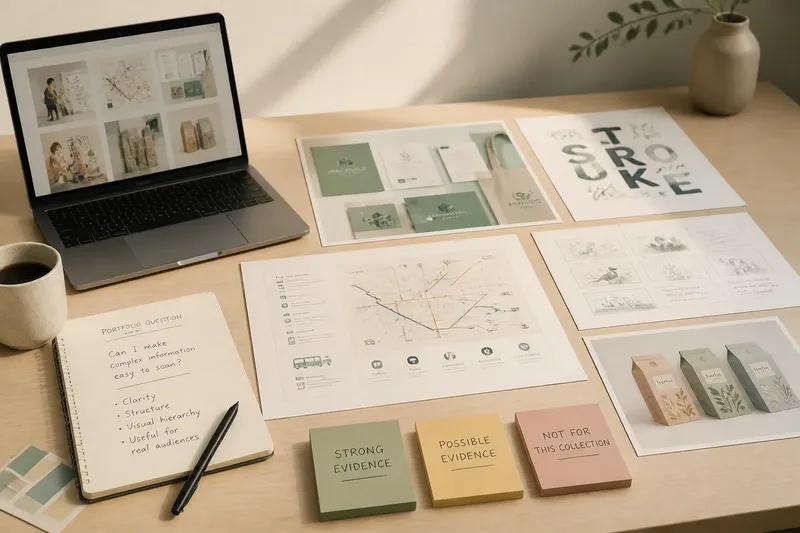
Choose an activity that puts the question within reach. If you are curious about clay, work with air-dry clay at a table rather than signing up for a broad course. If you are drawn to data visualization, make one chart from a small set of information rather than trying to become “good at data.” Keep preparation simple so you can pay attention to the activity itself.
Before starting, decide what you will notice. Which part holds your focus? What makes you want to try again? What confuses you in a way that makes you curious? These are clues about the next question, not evidence that you have or lack an innate strength.
Say you are curious about making short audio stories. You have a phone and a quiet room, and you record a brief voice note. You listen for whether you enjoyed shaping the story, speaking aloud, or trimming pauses. If editing catches your attention, your next question might be how cuts affect a listener’s sense of pace. There is no need to decide whether you are “a storyteller.”
Which kind of trial fits your curiosity?
When is a sampler the right choice?
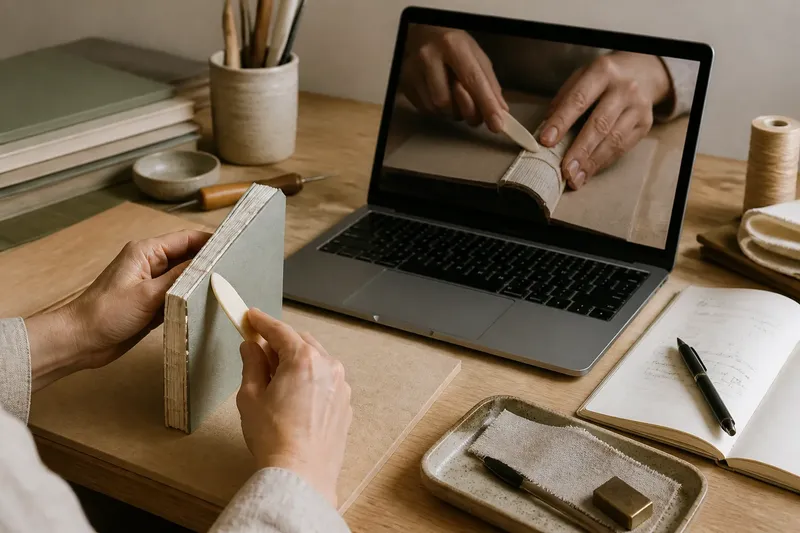
A sampler suits an interest with several appealing parts and no obvious starting point. Try a small taste of each part, with similar effort, then compare which one raises questions. Someone curious about bookbinding might fold a simple booklet, look at binding styles, and sew a paper signature. The aim is to notice what they want to understand better.
This approach helps when you do not yet know the shape of the field. It can also expose a mismatch between an activity’s appealing image and its ordinary work. If you like the look of ceramics but dislike shaping clay, that is not a failure. It is useful information about where your interest may lie.
When should you repeat one small task?
Repeat a task when you already know which activity attracts you but cannot tell what part is difficult or satisfying. Keep the task narrow and change one condition at a time. A beginner interested in sketching faces might draw the same simple object from different angles on separate occasions, noticing whether observation, proportion, or line-making holds their interest.
Repetition can make subtle questions easier to see. A task may feel less puzzling once you understand its basic shape, or the expected challenge may turn out to be less interesting than another part. Tiredness, a noisy room, or unfamiliar tools can also affect one attempt, so treat it as a snapshot rather than a verdict.
What does a constraint-based trial tell you?
A constraint-based trial adds a real limit, such as using only two colors, working from a short prompt, or making something for a specific reader. Choose this option when you want to see how a skill behaves under a condition that resembles the work you care about. A songwriter might try writing a verse without rhyme to notice whether the constraint sparks curiosity about rhythm or becomes a distraction.
Constraints can reveal preferences that an open-ended task hides. They can also distort the experience if the limit is arbitrary or too demanding. Pick one related to your interest, and keep the trial modest enough to tell whether the underlying activity still appeals.
How do you choose a trial without overthinking it?
Use the simplest option that can answer your current question. If you cannot name what interests you, sample. If you know the activity but not the sticking point, repeat one task. If you want to understand how the work changes under a relevant condition, add a constraint.
Write a one-sentence question before you begin. Make it about the activity, not your identity: “Do I enjoy revising a paragraph for sound?” is more useful than “Am I a writer?” The first invites observation. The second asks a brief encounter to settle something far too large.
- Check whether you can name a specific curiosity; if yes, choose a task that puts it in view, and if not, sample a few parts of the activity.
- Check whether you already know which activity attracts you; if yes, repeat one narrow task, and if not, avoid committing to a long course before sampling.
- Check whether a real-world limit matters to your question; if yes, add one relevant constraint, and if not, keep the task open-ended.
- Check whether the needed materials are already available; if yes, begin with them, and if not, borrow or improvise before buying specialized equipment.
- Check whether your stopping point is clear; if yes, finish at that point and record what you noticed, and if not, define a small endpoint such as completing one draft.
- Check whether the task asks for extra preparation or polish unrelated to your question; if yes, strip that work away, and if not, start as planned.
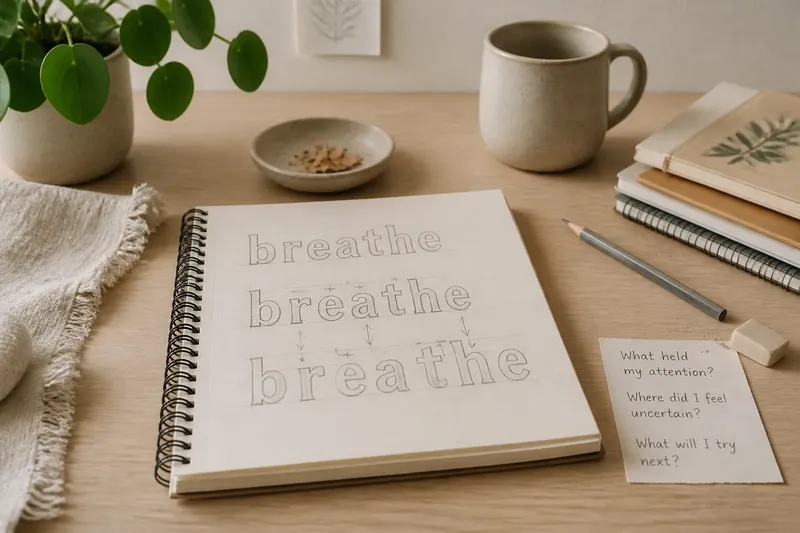
For a first lettering trial, a pencil and scrap paper are enough to explore whether you like shaping forms. Buying a full set of markers is not worth the effort yet.
What should you do with what you notice?
After the trial, record three things: what held your attention, where you felt uncertain, and what you would willingly try next. Keep observations specific. “I liked it” gives you little to work with; “I liked adjusting the spacing, but I did not know how to make the letters feel consistent” points toward a learning need.
Imagine you have a pencil, scrap paper, and ten minutes to try lettering. You write the same short word in block letters, then adjust the spacing between them. You notice that drawing each letter feels routine, but moving the letters closer or farther apart keeps your attention; the unfamiliar pencil grip is awkward, yet it does not make you want to stop. Your next action is to keep the pencil and practice spacing a few different words, rather than buying markers or deciding whether you are naturally talented at lettering.
Separate friction from disinterest. A task can feel awkward because the tool is unfamiliar, the instructions are unclear, or the first attempt asks too much at once. If you remain curious about the problem, try a simpler version or seek a focused explanation. If the activity itself leaves you cold, set it aside without turning that choice into a statement about your capacity.
Choose one next action tied to your notes. You might watch a short demonstration of a particular technique, borrow a tool, ask someone a narrow question, or repeat the task with one change. Avoid expanding into a broad plan before you know what you want to learn.
What questions help you read an early result?
Does one awkward attempt mean I lack talent?
No. A short trial reflects the task, setting, energy, and familiarity with the tools as well as your current skill. Treat difficulty as a clue about what to simplify or learn next, not a verdict on your potential.
Should I compare my first attempt with finished work?
Usually not. A first sketch, recording, or draft beside someone else’s polished result answers a different question. For discovery, compare what you expected to enjoy with what actually held your attention.
What if I enjoyed one part but disliked another?
That distinction can narrow your next question. If shaping clay feels tedious but decorating it is absorbing, try a small surface-design task before deciding whether the broader field suits you.
How many clues do I need before choosing what to learn?
You do not need a complete picture. One specific observation can support a modest next action, such as repeating a task or asking about one technique; you can revise your direction as you learn more.
A small learning experiment earns its place when it sharpens your next question. Choose a sampler, repetition, or constraint that fits your uncertainty, notice concrete details, and follow one clue. The outcome need not be a new ambition. Sometimes the useful discovery is knowing which part of an interest you want to leave unexplored for now.