Practice Alone or With a Partner? Choose by the Task
Practice alone or with a partner? Match solo repetition or immediate exchange to the skill you want to build, and make each session more useful.
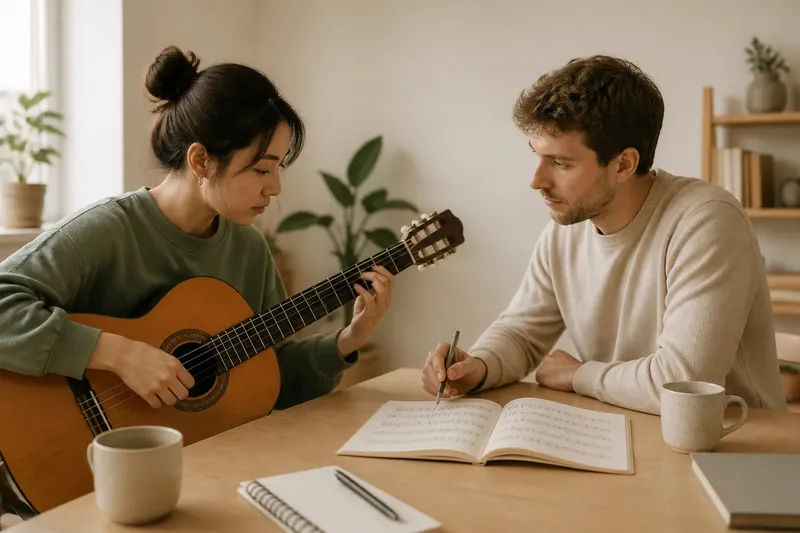
You sit down to practice a difficult guitar passage, and your friend is ready to play along. Should you work together or ask for the room to yourself? Practice alone or with a partner is not a personality test. It is a choice about what the task needs: room for repetition, or another person who can respond.
Either format can help, and either can get in the way. Solo work may leave a blind spot untouched; paired work can turn into an agreeable conversation that never reaches the hard part. When practice stalls, look at the task and the trouble in front of you before changing the format.
Why does solo practice feel stuck?
Solo practice gives you control over pace, sequence, and repetition. That is useful when you need to slow down a guitar transition, rehearse a speech opening, sketch the same form several ways, or work through a tricky passage in a language. You can pause at the exact point of confusion and return to it without asking anyone to wait.
But control can become a closed loop. You repeat what feels familiar, miss a recurring error, or spend the whole session polishing a small detail because no one is there to ask what the larger goal is.
- Problem: You keep repeating the comfortable part. Usually, the difficult section has no clear place in the session. Mark the exact moment where the task changes or breaks down, then begin there. Put the easier material back in only when it helps connect the sections.
- Problem: You cannot tell whether the result is improving. The target may be too vague. Choose an observable signal, such as whether a spoken explanation reaches its point without a detour, or whether a drawing communicates the intended shape before details are added. Notice that signal after a few attempts rather than grading every tiny movement.
- Problem: You have practiced a mistake until it feels natural. Familiarity is not the same as accuracy. Slow the task, compare what you did with a clear reference such as a marked score or written prompt, and isolate the point where the two diverge. If you cannot identify the mismatch, that is a useful reason to bring in another person.
Solo practice works best when the aim is clear enough to guide your attention, but not so narrow that you lose sight of the whole task. A short note before you begin can help: what are you trying to do, and what would count as a visible sign that it worked?
Why does paired practice feel awkward?
A partner adds another point of view. They can hear a presentation as an audience member, play the other part in a scene, ask for a missing explanation, or respond to a musical phrase in real time. That exchange is especially useful when the skill depends on timing, listening, turn-taking, or making an idea understandable to someone else.
The trouble starts when the partner’s role stays fuzzy. One person may expect feedback, while the other thinks they are there to encourage. Or both may offer so many suggestions that the person practicing cannot tell which one to try.
- Problem: Feedback feels personal or too broad. Usually, the request is not specific enough. Ask for one kind of response: “Tell me where the explanation becomes hard to follow,” or “Play the passage with me and notice where our timing separates.” Keep comments tied to the task, not to a judgment of the person.
- Problem: The partner takes over. A more experienced person may demonstrate, correct, and explain until the learner has little room to attempt the skill. Agree that the learner gets the first try and chooses which suggestion to test. A partner can point out what they observed without dictating every next move.
- Problem: Practice becomes a pleasant chat. Conversation may be useful, but it is not the same as practicing. Set a small shared task before starting, such as giving a short explanation and asking the listener to name its central point. Keep the exchange brief enough to leave time for another attempt.
A paired session does not require an expert. A peer can serve as listener, audience, practice partner, or timekeeper. The useful question is not “Who knows more?” but “What can this person notice or respond to that I cannot get from working alone?”
How do you choose a practice format for the task?
Start with the part of the skill you are trying to change. If it needs repeated attempts at your own pace, begin alone. If it depends on another person’s response, include a partner. Many skills contain both kinds of work, so the best choice may be a sequence rather than a permanent rule.
Try this order:
- Name the action. Replace “get better at drawing” with a task such as “make the main shape readable before adding texture.”
- Identify what is missing. Do you need more attempts, a clearer reference, an audience reaction, or a partner to play the other role?
- Choose the smallest useful format. Work alone for focused repetition; invite someone in for a response that only another person can provide.
- Agree on the partner’s role. If you work together, say whether you want a listener, a collaborator, a reader, or a source of specific feedback.
- Check the result against the task. After the session, ask whether the original action became easier to do or easier for another person to follow.
Say you are preparing to explain a new design idea at a team meeting. Imagine the explanation keeps wandering before it reaches the proposal. You could first work alone to make the sequence clear, then ask a colleague to listen and repeat what they understood as the main point. If their version misses the proposal, you have a concrete place to revise; if it lands, you can focus your next solo attempt on delivering it clearly.
That sequence keeps the two formats distinct. The solo portion is for shaping the explanation at your pace. The paired portion is for checking what another listener receives. The partner does not need to rewrite the whole presentation or judge whether the idea is good.
What if both formats seem to fail?
Sometimes the format is not the main problem. The task may be too large, the goal unclear, or the practice setting poorly suited to concentration. “Practice the whole song” can feel overwhelming; “work on the transition into the chorus” gives attention somewhere to land. “Get better at feedback” is broad; “ask one question before offering a suggestion” can be tried and noticed.
Change one condition at a time. If solo practice wanders, make the target smaller before adding a partner. If paired practice gets noisy, clarify the roles before abandoning the exchange. If the work still feels unproductive, pause to ask whether you are practicing the skill itself or only a convenient nearby task.
It is not worth building an elaborate schedule to decide who practices with whom. A brief choice based on the task is usually enough. Keep a light note of what you tried and what happened, so the next session starts with a useful clue rather than a fresh guess.
Which practice format fits your situation?
When should I practice alone?
Choose solo practice when you need uninterrupted repetition, control over pace, or time to notice your own decisions. It is a strong fit for breaking a complex task into parts before bringing those parts together.
When should I practice with a partner?
Choose paired practice when the skill involves listening, responding, timing, explanation, or another person’s interpretation. Agree on the partner’s role first so the exchange serves the task rather than becoming unsolicited coaching.
Can I switch between solo and paired practice?
Yes. You can work alone to prepare an attempt, then bring in a partner to respond to it, or use a conversation to identify a question worth working through alone. The order depends on whether preparation or outside response is the current need.
What if my partner and I have different skill levels?
Different experience can still be useful if the roles are clear and the learner retains room to try. A less experienced partner can offer a fresh audience response; a more experienced one can focus on one observation instead of taking over the task.
Practice alone or with a partner is a decision you can make anew as the skill changes. When your next session stalls, identify whether you need another attempt at your own pace or a response from someone else. Then choose the format that supplies that missing ingredient.